|
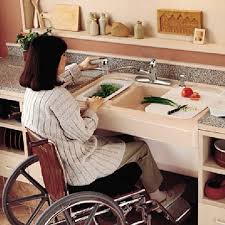
Our "aging in place" kichen design recommendations deliver the convenience, comfort and safety that our clients demand: customized designs that perfectly accommodate each individual's preferences and requirements.
The major features that we recommend are presented below:
The general layout.The time-honored "work triangle" is incorporated into the layout to minimize travel distance among the three major kitchen work areas: the stove, the sink and the refrigerator.
- 50" turnaround spaces allow for ease of wheelchair access and maneuverability
- Work areas at lower counter heights with open spaces below are included, again to facilitate wheelchair access.
Appliances. Safety and convenience of use are the guiding principles of our appliance recommendations. Fortunately there are many viable options on today's market as vendors increasingly address the significance of the growing "aging in place" market segment.
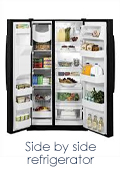
- Refrigerators. Recommendations favor side-by-side configurations for ease of access with minimum bending and stooping, and provide the added convenience of fresh water and ice availability at the front door.
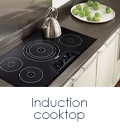
- Cook tops vs. ranges. Induction cook tops are recommended over conventional gas ranges and cook tops: they heat quickly, there is no flame--an important safety consideration--they cook more efficiently and are easy to clean.
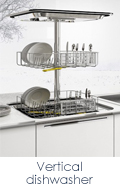
- Dishwashers. Recommendations favor top-loading models for "aging in place" kitchens because they require less bending and stoopin to load and unload, they clean more effectively and they can handle larger pots and pans.
- Wall and microwave ovens. They can be mounted at any height required by the user to minimize the requirement for stooping and bending. It's also easier to load and unload their contents, providing an additional degree of safety.
- Sinks. To accommodate wheelchair users, sinks need to be mounted at lower heightd with open space beneath, they must have lever-operated handles mounted at the side of the sink, they need to have a shallower depth of about 6", and must have an anti-scald device to prevent hot water temperatures from exceeding unsafe levels.
Accessible storage and cabinetry. Vendors are providing ever-increasing options for "aging in place" kitchen cabinetry and storage. Safety and convenience are the guiding principles of our cabinetry and storage recommendations.
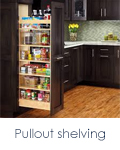
- Pullout shelving and drawers. Pullout shelving and drawers are replacing door-front cabinetry and stationary shelving. Pullout shelving and drawers greatly increase the accessibility of their contents, which range from pots and pans, to appliances, to dishware, to utensils and so on. They are prevalent in lower cabinetry.
- Rollout shelving units. Rollout shelving units as high as five feet or more make excellent pantry item storage. They permit maximum visibility and accessibility of their contents.
- Heavy stuff low, light stuff high. The goal is to avoid lifting heavier kitchen equipment, like larger pots and appliances, above counter top heights, which are placed in appropriately sized pullout drawers; lighter objects such as glassware are placed in upper shelving or glass front cabinets.
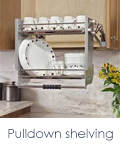
- Pull-down shelving. Storage systems which enable shelves to be easily raised and lowered can be used to great effect in upper kitchen cabinetry. They greatly increase the practical utilization of all available upper cabinet space, enhancing convenience and safety.
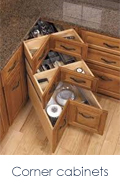
- Corner cabinetry. Corner cabinet design has advanced well beyond the traditional Lazy Susan approach of yesteryear. Pullout drawer versions are now available which enable full, practical and convenient access to the corner cabinet's space volume and are top-loaded to minimize bending and stooping.
Non-skid flooring. The following factors need to be considered when choosing kitchen flooring materials:
- Slip resistance. Falls, particularly those that occur in the home, are the most frequent cause of injuries to senior citizens. "Aging in place" flooring material must be chosen with fall prevention as the major criterion. Vinyl and linoleum flooring can be had with matte finishes which are not slip resistant when wet. Ceramic tiles are also available with slip resistant finishes, but these should be avoided if the manufacturer will not guarantee this slip resistant quality.
- Comfort under foot. "Aging in place" flooring should be comfortable to travel over whether on foor, in a walker, with a cane or in a wheelchair. Both vinyl and linoleum have a resilient feel underfoot. Their resilience provides some degree of cushioning in the event of a fall.
- Maintenance. Both vinyl and linoleum floorings are stain resistant and easy to mop and vacuum.
- Cost. Vinyl and linoleum are cost-competitive with most other flooring material options. And, there are enough design options to satisfy virtually everyone's tastes. Generally, vinyl tends to be less expensive than linoleum.

|
|